You can always hunt in your free time
One sentence that has travelled with me for thirty years.
I was fifteen when I first understood that my life was not entirely mine to choose.
It was 1996, in the north of Sweden, and I wanted to go to Kalix naturbruksgymnasium, the Swedish upper-secondary school for the land-based trades. Forestry, agriculture, animals, machinery, wildlife management.
I wanted to become a professional hunter.
Before school, Dad and I would go out to check our traps for mink and marten.
You learned to read a trap from a distance. A closed hatch meant something was inside. Then, as you came closer, the sounds of an angry mink. I still remember the excitement of it. Caught something. That adrenaline, before the day had even started.
It was just part of the morning. Hunting and fishing were what you did with your spare time, the way other places have sport.
My dad hunted. So did my uncles. So did my granddad. So did everyone in the village. It was a deep tradition, older than any of us. It was in my DNA.
I wanted to make it the centre of my life, to spend my days in the bush, learning the kind of work where the land provides and you learn to provide with it.
That made sense to the boy I was.
I grew up in a village in the middle of nowhere, with forest, rivers, and the Bay of Bothnia always close.
This was the Arctic north, where winter is real. The sun disappears for months. It can be minus thirty-five, snow comes by the metre, and the ocean freezes over.
The land of the midnight sun, the polar nights, the northern lights. The land of contrasts.
The outdoors was not a weekend lifestyle. It was literally just outside the door.
As a boy I borrowed survival books from the library and taught myself about snowshoes and shelters, bows and arrows, navigating without a compass, making fire with almost nothing.
My parents were people of the forest and the sea, and so were theirs, for generations.
It was my world. It was also theirs.
My parents said no.
No to the naturbruksgymnasium. No to making the forest the centre of my life.
Not because they did not understand that world. They understood it deeply.
At fifteen, it felt like being told what to do at the exact age when I thought I should start deciding for myself. I was not easy to steer, and the path I wanted was the one I already knew. The forest, the land, the practical life close to weather and seasons.
But they saw it differently. That door, they knew, was already open. The forest was there. The rivers were there. The sea was there. Hunting and fishing were not things I needed a school to give me permission to do.
Other doors were closed.
They wanted the science programme. University preparation. A wider path. A set of doors I could walk through later, even if I did not yet know why I would need them.
The sentence I remember was simple.
You can always hunt in your free time.
At fifteen, I heard it as a door closing.
I was furious.
There is a particular kind of anger that belongs to that age.
Not childish, not wrong, just trapped inside the small room of what you can see.
What I could see was that someone else had reached into my life and decided my path.
My father was born in the summer of 56. He started at the steel mill when he was eighteen. By the time I was choosing school he was forty, and had already spent twenty-two years there. More years inside that system than I had been alive.
The mill provided for us, and for the region. My father did not stand still inside it. He climbed, because of who he was. His work ethic, his knowledge, his way with people. The mill was not the only work. He started a rainbow trout farm, a pioneer in that part of Sweden.
In early summer, under the midnight sun, he fished strömming (herring).
Later in autumn, when the ocean turned cold, there was sik, the whitefish of the Baltic, in stationary traps set out in the archipelago. Löja too, the small schooling fish whose roe, löjrom, is called the gold of the ocean.
He fished in all weathers, sometimes on his own, pulling nets from the cold water, keeping his footing on a pitching boat, doing what his father had taught him to do.
Work hard.
That was in the blood.
My mother’s from the same north. She came from a working-class family as well. My grandmother divorced early, unusual back then. She raised her children by herself while working factory floors.
My mother became a nurse, the first in her family to get a degree. In our house, the idea that education could move a life was not abstract.
Mum taught us the names of things. Plants, birds, berries, mushrooms, tracks. What grew where, what was useful, what to leave alone. Building a strong bond to the natural world around us.
She taught us to see the beauty in what was close. We made adventures out of what was under our noses, riding our bikes into the forest, building hideaways under the trees, fishing in the nearby river.
So both my parents knew the world I wanted. They knew the forest. They knew the water. They knew the life I wanted was real.
But they had also seen how the world worked from there. Ability and hard work are not the only things that open doors. They knew education changes how a person can move through the world. Which rooms listen. Which choices appear. Which doors open before you even know you will need them.
So when they looked at me, I do not think they saw a boy being pushed away from the forest. They saw a boy standing in front of one door that was already open, and many others that were not.
And they pushed.
My grandfather had gone further than any of us, before I was born.
America, in the 1950s. Alaska.
We never got much of the story. I never got to meet him. He died when Dad was twenty-one, and whatever he had seen over there stayed mostly unspoken. But he came home with ideas. Rainbow trout farming in northern Sweden. Trawl fishing in the Bay of Bothnia. The kind of ideas that make sense to a man who has seen somewhere else and returns unable to pretend the world is only the size it used to be.
That restlessness did not disappear. It moved down a generation. Dad had dreams too. Australia, Norway, America, oil platforms, other SSAB plants on the other side of the Atlantic. Some of it remained conversation. Some was interrupted by illness.
He was thirty-three when he took his first holiday. Not just his first abroad. His first, full stop. He was always working otherwise. Always fishing.
Then it moved again. To me.
The doors opened. I studied. I moved from home when I was nineteen. In some ways, I never really came back.
That is the part I find harder to hold. My parents wanted to give me options, and they did. They wanted me to have a wider life than the one that had been available to them, and I did.
But a wider life is wider in every direction. It gives you work, education, movement, language, distance. It gives you the confidence to cross water and the habit of looking past the horizon. It gives you a way out.
The thing they gave me worked so well that I left.
Years later, when New Zealand was no longer an idea but a real decision in front of us, I asked Dad for advice. Take the job or not. Stay with the life we knew, or take the family to the other side of the world.
He sent me a letter.
He wrote that he was happy I had the chance to have this adventure, that he had seen the network I had built on the other side of the Earth, that they were proud of me.
Then he wrote about his own dreams. Australia, Norway, America, my grandfather crossing the Atlantic and becoming an American citizen for a while. The old family pattern of looking outward.
And then he turned back to my situation. He had understood that my boss expected me to give up time with my family for the company, and he wrote that it was never worth putting family second.
Money has no value if you do not have time to use it.
Freedom matters.
The line I keep returning to is this:
Hemmet finns ju alltid kvar även om det är på andra sidan Jorden.
Home will always be there, even on the other side of the world.
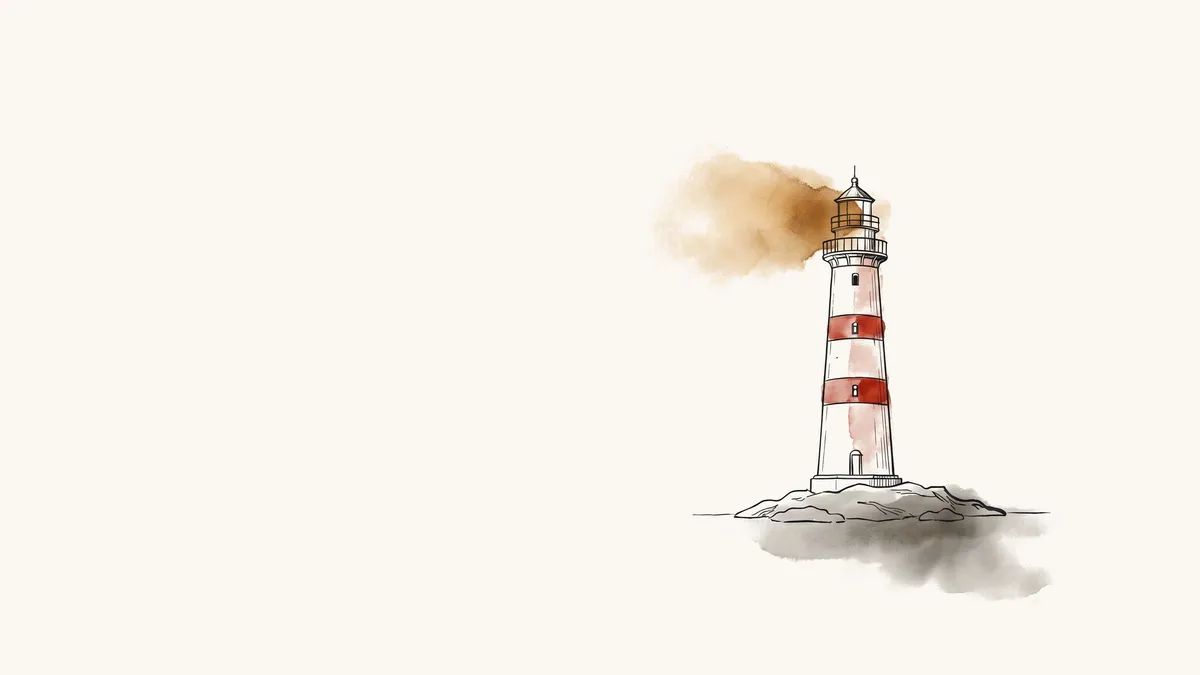
When I graduated, someone gave me a small lighthouse with a candle in it.
My parents, I think, though I remember the meaning more clearly than the giver.
Home would always be there, standing tall, leading me back if I ever got lost.
At nineteen, I left.
Now my oldest daughter is eighteen. She has finished school. Canada is next, then Sweden. She has not booked the return ticket.
And now I am sitting where my parents once sat.
Pride.
Excitement for her to try her wings and see the world.
Reconnect with her roots.
Sadness.
When I was born, my world was small. Hers never has been.
She was born in Sweden, moved to New Zealand when she was seven, and grew up under the southern stars.
I started learning English words when I was ten.
She is bilingual, and now old enough to cross the world in the other direction.
I want to be careful with my words. I know now how long they can last.
At fifteen, I thought my parents were making my world smaller.
They were trying to make it larger than theirs had been.
The anger was real. So was the gift.
I still hunt in my free time.
Just not the way I imagined back then.